If you spent the last few hours scouring Kenya’s eCitizen portal looking for the dedicated Digital Nomad Visa that President William Ruto announced at the Bomas of Kenya, take a breath.
You did not miss a hidden government link.
Your internet connection is not playing tricks on you, and the immigration portal is not broken. When international news desks ran breathless headlines declaring that Kenya had launched Africa’s newest digital nomad visa, they skipped an essential piece of administrative reality: Kenya never built a standalone nomad visa portal because it did not need to.
The legal framework was already on the books.
Instead of creating an untracked, bureaucratic new visa class from scratch, Kenya’s Ministry of Interior formally codified remote worker residency directly into the country’s existing immigration statutes under Legal Notice 155 of 2024. That legislation anchored the digital nomad framework firmly inside the battle-tested Class N Work Permit category.
Class N is the real legal doorway.
It allows foreign consultants, technical specialists, and independent remote professionals to legally live in Nairobi, run their offshore businesses, and explore the country without looking over their shoulder at immigration checkpoints. Yet navigating this permit requires unvarnished street-level knowledge rather than promotional tourism brochures.
Here is how the system actually works on the ground.

What President Ruto Announced Versus What the Gazette Actually Says
In October 2024, during the 14th Magical Kenya Travel Expo, President William Ruto stepped up to the podium and announced that Kenya would introduce a digital nomad work permit alongside a simplified electronic transit framework.
Global travel blogs erupted in excitement.
Dozens of third-party visa aggregators quickly built flashy landing pages offering so-called instant Kenyan digital nomad visas for fees ranging from two hundred to five hundred dollars. Thousands of travelers handed over credit card details, expecting an automated electronic sticker to appear in their email inbox.
Those third-party websites are completely unauthorized.
Under Kenyan constitutional law, an executive announcement at an industry expo establishes political intent, but it does not amend immigration statutes on its own. For any immigration category to carry legal force, the Cabinet Secretary for Interior and National Administration must formulate detailed regulations and publish a formal notice in the Kenya Gazette.
That official statutory enactment arrived through the gazetted Legal Notice 155.
Rather than rolling out a fragile separate tourist-nomad pass, the government integrated remote workers into Regulation 13 of the Kenya Citizenship and Immigration Regulations under the Class N designation, officially coded on government records as KEP/N. The official processing system lives exclusively on the Directorate of Immigration Services Electronic Foreign Nationals Services portal (eFNS).
Never pay an unverified visa aggregator.
Who Qualifies for Class N and the Myth of the Hundred Thousand Dollar Investment
The single most destructive misunderstanding surrounding Kenyan immigration is the myth that you must invest one hundred thousand dollars in cash to live and work in the country.
This expensive myth stems from conflating Class G with Class N.
Class G is designed strictly for commercial investors and foreign entrepreneurs who want to establish a local business, open a brick-and-mortar storefront, or trade within the domestic Kenyan market. Class G applicants must prove they have transferred at least one hundred thousand dollars into a Kenyan bank account and obtained formal clearance from the Kenya Investment Authority.
Class N requires zero local investment capital.
Class N is legally designated for prescribed professions and specialized consultants. That category covers software engineers, system architects, management advisors, creative directors, and remote agency contractors who derive all their revenue from overseas clients and employers.
You do not need to register a Kenyan corporation, hire local employees, or park capital in a domestic commercial bank to qualify. However, Legal Notice 155 established a strict financial floor that applicants must satisfy: you must demonstrate verified, regular foreign earnings equivalent to at least fifty-five thousand dollars per year.
Fifty-five thousand dollars is the statutory income baseline.
Immigration officers verify this threshold through certified bank statements and active client contracts. If your documentation shows consistent monthly deposits from foreign entities that meet this threshold, your financial eligibility is solid.
There is one non-negotiable legal boundary: you cannot work for the Kenyan market.
Class N grants legal residency to live in Kenya while servicing clients located elsewhere in the world. Taking a local salaried job, consulting for Kenyan-registered businesses, or accepting payment in Kenyan Shillings from local entities is strictly illegal and will result in immediate permit revocation.
Your money must flow from outside Kenya.
Understanding the One Hundred and Eighty-Three Day Tax Rule
Living abroad on a laptop often feels delightfully detached from local tax authorities, but the Kenya Revenue Authority operates with clear statutory parameters.
Tax residency in Kenya is governed strictly by physical presence under Section 5 of the Kenya Income Tax Act (Cap 470) administered by the Kenya Revenue Authority.
The core threshold is simple: if you spend one hundred and eighty-three days or more inside Kenya within any twelve-month tax calendar, you automatically become a Kenyan tax resident. You also qualify as a tax resident if you spend an average of one hundred and twenty days per year in Kenya across three consecutive tax cycles.
Crossing that day count has major financial consequences.
Non-residents are taxed only on income that is accrued in or derived from Kenya. Because a compliant Class N holder derives all their consulting income from overseas, non-residents remain shielded from local personal income tax on their foreign earnings. But the moment you cross the one hundred and eighty-three day threshold, the KRA asserts jurisdiction over your worldwide income.
Kenya taxes resident personal income on a graduated scale that rises rapidly, reaching thirty-five percent on monthly taxable earnings exceeding eight hundred thousand shillings, which is roughly six thousand one hundred and fifty dollars. For high-earning remote professionals, unmanaged tax residency can double your global tax liabilities.
Overseas employers also face potential corporate exposure.
If you are a full-time employee of a foreign corporation and you live in Kenya while signing contracts, negotiating deals, or managing regional staff, the KRA can argue under Section 15 of Cap 470 that your employer has created a Corporate Permanent Establishment in Kenya. That finding exposes the parent foreign company to Kenya’s thirty percent corporate tax on attributable profits.
Smart remote workers handle this with two clean practices.
First, structure your working relationship as an independent contractor or consultancy rather than direct corporate employment. Second, pace your stays under one hundred and eighty-three days per year, combining four to five months of Nairobi base life with regional travels across East Africa, keeping your tax profile clean.
Official Statutory Fees and the eFNS Financial Realities
Budgeting for a Kenyan work permit requires separating real government fees from facilitator markups.
All official permit fees are fixed by national legislation and paid directly through the eFNS portal using card payment or M-Pesa. Here is the verified statutory fee schedule for the Class N permit:
| Permit Fee Component | Statutory Amount | When It Must Be Paid | Operational Purpose |
|---|---|---|---|
| Class N Application Fee | $200 USD | Upon Form 25 digital submission | Non-refundable processing fee paid directly on eFNS. |
| Annual Issuance Fee | $1,000 USD per year | Upon formal approval notification | Granted for 1 or 2 years ($2,000 total) before passport endorsement. |
| Refundable Security Bond | $500 to $1,000 USD | Prior to physical endorsement | Cash deposit or Kenyan commercial bank guarantee held by immigration. |
| Special Pass (Form 32) | $200 USD per month | During application review | Temporary bridging pass to prevent illegal overstay penalties. |
Never pay cash to individuals outside immigration halls.
Every genuine government fee generates an automated eFNS invoice with a unique tracking number and an official electronic receipt. If an intermediary asks for cash in a parking lot, walk away immediately.
Bridging the Processing Window and the Fifty Dollar Daily Overstay Trap
The most common administrative pitfall for incoming remote workers is miscalculating the processing timeline.
The Directorate of Immigration Services officially quotes four to eight weeks to process a Form 25 application. In practice, background checks, security committee reviews, and document verification frequently extend that window to ten or twelve weeks.
Many travelers enter Kenya on a standard ninety-day Electronic Travel Authorization, which we detailed in our guide to visa-free African countries and entry rules.
They submit their Form 25 on eFNS during their second week in Nairobi, assuming that having a pending application legally protects them. It does not.
A pending application provides zero legal status.
If your ninety-day tourist ETA expires while your Class N permit remains under review, you are technically an unlawful alien. Immigration officers at Jomo Kenyatta International Airport levy a strict statutory fine of fifty dollars per day for every day of illegal overstay when you exit.
Overstaying can cost you hundreds of dollars in airport penalties and jeopardize future visas.
The legal shield is a Form 32 Special Pass. A Special Pass provides temporary legal residency for up to ninety days while your long-term permit is being finalized. Under the gazetted fee schedule, non-East African Community nationals pay two hundred dollars per month for a Special Pass.
Securing a sixty-day Special Pass costs four hundred dollars, but it guarantees total legal compliance while immigration officers complete their file review.
Always bridge your stay legally.
The Form Twenty-Five Document Dossier Checklist
Incomplete document dossiers are the leading cause of application delays on eFNS. Gather every item in clear PDF format before opening your digital file:
- Completed Form 25: Generated digitally through your registered account on the Directorate of Immigration Services eFNS portal via the official eCitizen gateway.
- Passport Bio-Data Page: Clear color scan showing at least six months remaining validity and two blank visa pages.
- Passport-Sized Photographs: Two recent color digital photos against a plain white background without hats or tinted glasses.
- Detailed Professional Cover Letter: Addressed to the Director General of Immigration Services at Nyayo House. State your profession, confirm all clients are outside Kenya, and explain why your work requires an extended base in Kenya.
- Client Retainers and Service Contracts: Active signed contracts demonstrating ongoing consulting engagements with corporate entities based outside Kenya.
- Three to Six Months Certified Bank Statements: Statements showing consistent foreign currency deposits meeting the fifty-five thousand dollar annual threshold.
- Police Clearance Certificate: An official certified criminal background check issued within the preceding six months from your home country or country of permanent residence.
- Curriculum Vitae and Degree Diplomas: Evidence of specialized professional competence in your chosen field.
- Proof of Kenyan Accommodation: A residential lease agreement, serviced apartment reservation, or Airbnb booking confirmation.
Label your PDF files cleanly before uploading.

Navigating Nyayo House for In-Person Biometrics
While document uploads and fee settlements take place online via eFNS, final biometric capture and passport endorsement require an in-person appearance at Nyayo House in Nairobi.
Nyayo House sits at the busy intersection of Kenyatta Avenue and Uhuru Highway in the central business district. It is a massive, high-security government complex, and handling your appointment requires preparation.
The golden rule is simple: arrive by six-thirty in the morning.
Biometric processing operates on a strict daily token queue. Crowds begin gathering along the perimeter security gates before dawn. Arriving at six-thirty puts you near the front of the queue, allowing you to complete your fingerprinting, photograph capture, and document verification by mid-morning.
Arriving at nine in the morning means waiting six hours in sweltering bays or being turned away because daily quotas have been exhausted.
Dress with conservative care.
Security officers at the outer gates enforce a strict institutional dress code. Visitors wearing shorts, tank tops, sleeveless blouses, miniskirts, or heavily ripped jeans are routinely turned away at the gate regardless of their appointment status. Wear clean trousers, closed shoes, and a collared shirt or covered top.
Leave your laptop at home.
Security personnel prohibit laptops, large tablets, cameras, and recording hardware inside the facility. If you bring a computer bag, you will be forced to leave it with informal street storage operators outside the compound, which carries significant security risks. Bring only your smartphone and a physical waterproof folder containing your printed Form 25, payment receipts, bank statements, and original passport.
Paper backups save the day.
Setting Up Daily Life Around Nairobi Infrastructure
Once your permit is secured, daily success in Nairobi hinges on mastering three infrastructural realities.
First, activate Safaricom M-Pesa on your first day.
Kenya is the most cashless society on the African continent. While Visa and Mastercard work in major supermarkets like Carrefour and high-end Westlands restaurants, daily life runs entirely on M-Pesa till numbers. Buy an eSIM at Jomo Kenyatta International Airport or at Sarit Centre in Westlands, register your passport, and top up your mobile wallet from foreign accounts using remittance apps like Wise or SendWave.
Second, demand an apartment with a full-load automatic generator.
Nairobi’s power grid, managed by Kenya Power and Lighting Company, experiences frequent interruptions, especially during rainy months. Many apartment buildings advertise standby power, but they only operate a small common-area inverter that powers hallway lights and the elevator.
Common-area inverters leave your apartment wall sockets and Wi-Fi router completely dead.
Before signing a lease or committing to a monthly Airbnb in Westlands, Kilimani, or Lavington, confirm that the building features a full-load automatic diesel generator that powers the entire interior apartment electrical circuit within fifteen seconds of a blackout.
Third, carry comprehensive private international health coverage.
Kenya’s public healthcare system is undergoing a massive administrative overhaul, transitioning from the historic National Hospital Insurance Fund to the Social Health Authority and Social Health Insurance Fund. The new system relies on a mandatory two-point-seven-five percent payroll levy that causes administrative friction for temporary foreign residents.
Avoid public clinics entirely.
Nairobi boasts outstanding private medical institutions, including Aga Khan University Hospital in Parklands and The Nairobi Hospital in Upper Hill. Secure an international health policy with direct billing privileges at these two private hospitals to ensure immediate access to world-class medical specialists.
The Ultimate Nomad Perk: Weekend Safari Fly-Ins from Wilson Airport
The true reward of basing your remote work life in Nairobi is that Africa’s most legendary wildlife wilderness lies right at your doorstep.
No other global capital offers a wilderness escape during a Friday lunch break.
Whether you budget for a rustic day trip or an all-inclusive bush flight, balancing daily city expenses against our African safari cost breakdown keeps your finances grounded.
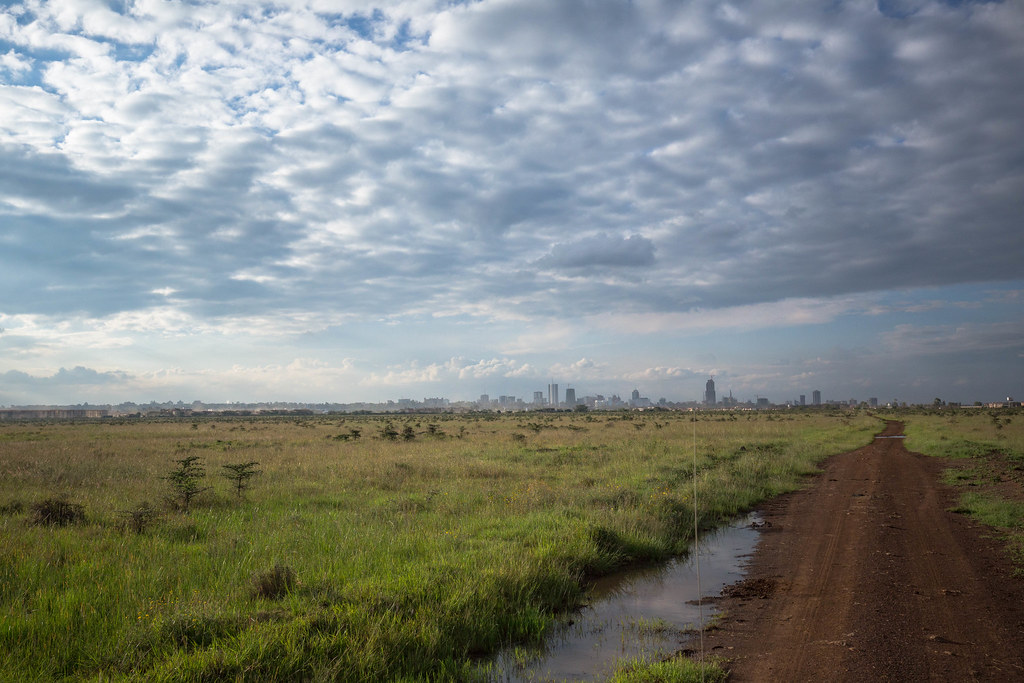
Nairobi National Park sits just fifteen minutes south of Upper Hill. You can wrap up a morning video conference with European clients, pass through the park gates by noon, and spend three hours photographing endangered black rhinos, lion prides, and giraffes browsing against the backdrop of glass city towers.
When the weekend arrives, Wilson Airport becomes your personal departure gate.
Wilson Airport in Lang’ata is Nairobi’s domestic aviation engine. Flights on bush carriers like Safarilink and AirKenya reach remote dirt airstrips in the Maasai Mara in just forty-five minutes. You can close your laptop in a Westlands coworking space at one in the afternoon and be watching elephant herds cross the Mara River with a sundowner in hand before four-thirty.
To plan your route and understand savannah ecosystems before heading into the bush, consult our comprehensive breakdown in The East Africa Safari Guide.
Savannah travel demands specialized aero-medical protection.
Standard travel insurance policies will cover hospital beds in Nairobi, but they routinely exclude or delay chartered emergency air ambulance rescues from remote bush airstrips. An annual membership with AMREF Flying Doctors through their Maisha evacuation plan costs between thirty-five and fifty dollars per year.
The Maisha plan guarantees immediate emergency dispatch of ICU-equipped aircraft directly to remote park airstrips, flying injured or critically ill travelers directly to Wilson Airport for immediate ambulance transfer to Aga Khan Hospital. For remote workers taking regular weekend safari trips, it is the most valuable fifty dollars you will spend all year.
Before packing your bush bags, review our essential field recommendations in the African Safari Packing and Safety Guide to ensure you carry the right gear for light aircraft limits.
Kenya consistently ranks at the top of our curated index of the top African destinations for remote workers because it blends enterprise-grade digital infrastructure with immediate access to natural wonder.
For a broader regional perspective on how everyday living costs and currency values behave across East, West, and Southern Africa, explore our macro field study on what $100 buys across Africa.
To see how daily spending breaks down across neighborhood dining, commuter transit, and domestic travel in Kenya, consult our real-world guide on what $100 actually buys in Kenya.
Frequently Asked Questions About Kenya Class N Work Permits
Can I Bring My Spouse and Children on a Class N Permit?
Yes. Once your primary Class N permit receives formal approval, you can apply for Dependent Passes for your legally married spouse and minor children under Form 28 on the eFNS portal. Spouses cannot take local employment in Kenya under a Dependent Pass without securing their own independent work permit.
How Long Is the Class N Permit Valid and Can It Be Renewed?
The Directorate of Immigration Services issues Class N permits for initial validity periods of one or two years. The permit is fully renewable upon demonstrating continued offshore client engagements, regular foreign income deposits meeting statutory thresholds, and continuous compliance with Kenyan immigration regulations.
Can I Open a Local Kenyan Bank Account with Class N?
Yes. Endorsement of a Class N permit in your physical passport allows you to register for a personal Kenya Revenue Authority PIN under non-resident or resident status depending on your physical stay duration. With your endorsed permit, passport, and KRA PIN, tier-one commercial banks like Standard Chartered Kenya, I&M Bank, and NCBA will open local foreign currency and Kenyan Shilling accounts.
What Happens If My Class N Application Is Rejected?
If the Director General of Immigration Services rejects an application, an official notification letter will state the statutory grounds, which usually relate to insufficient foreign revenue documentation or failure to satisfy the prescribed profession classification. Applicants have the legal right to submit a formal appeal to the Cabinet Secretary for Interior and National Administration within thirty days of notification.