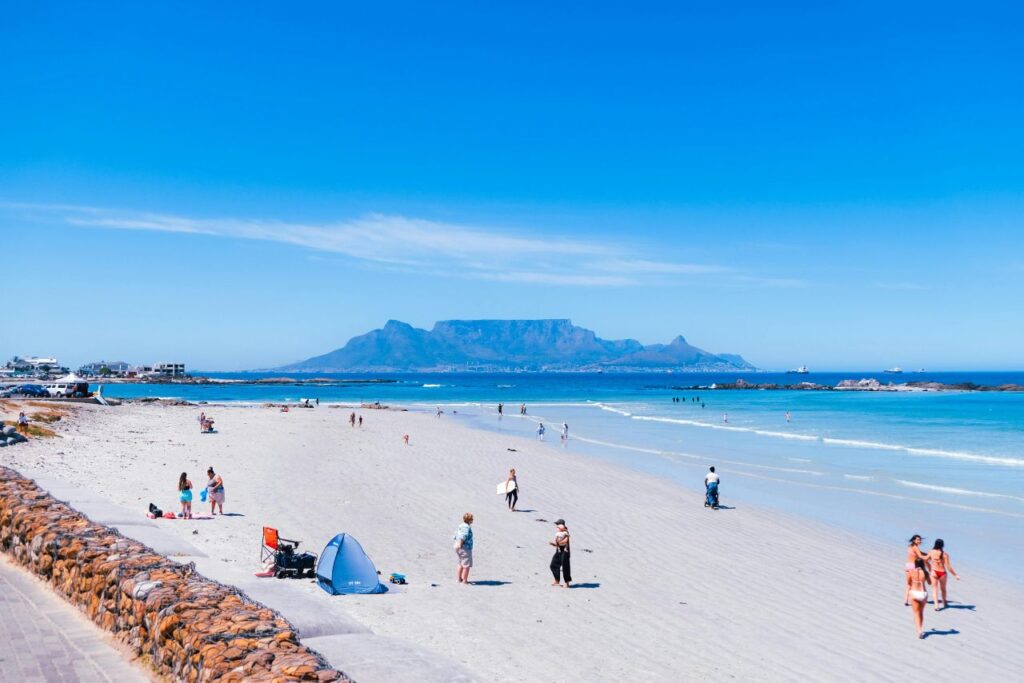
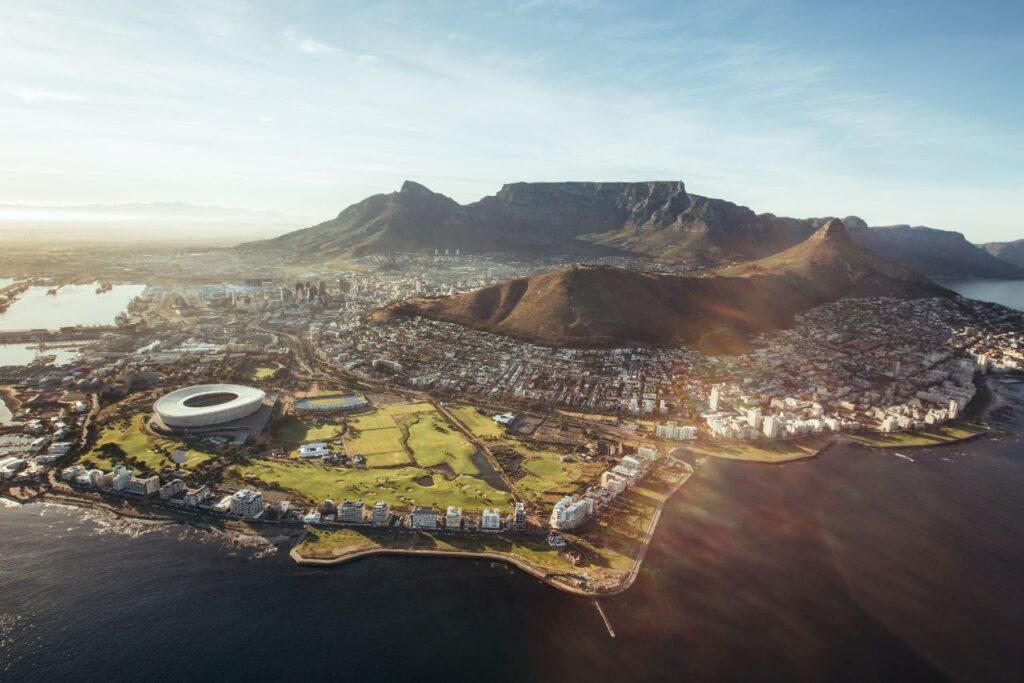
Cape Town presents a striking duality for global remote workers. The city pairs dramatic mountain backdrops, Atlantic sunsets, and world-class culinary scenes with complex spatial security dynamics.
Living here productively requires understanding the neighborhood geography rather than relying on generalized crime statistics. With proper district selection, certified legal documentation, and standard urban vigilance, thousands of international remote workers thrive across the Mother City.
The Ground-Level Reality: Crime and City Improvement Districts
National crime statistics often paint South Africa with a broad brush. However, safety in Cape Town is deeply spatial and neighborhood-dependent.
The primary security pillar in central nomad corridors is the City Improvement District (CID) network. Districts like the Cape Town Central City Improvement District, Sea Point CID, and Green Point CID deploy dedicated private security patrols, mobile kiosks, and 24/7 CCTV surveillance networks.
These private-public partnerships dramatically reduce opportunistic street crime within their patrol zones. Outside CID-patrolled zones, personal awareness and vehicle transit become significantly more critical.
Official Tourism Safety Framework vs. Ground Realities
The South African government actively positions the country as a welcoming global tourism and nomad powerhouse. Through the National Department of Tourism, authorities deployed over 2,300 trained Tourism Monitors and established the Tourism Victim Support Programme.
However, remote workers must understand the real-world gap between official tourism policy and day-to-day urban living. Tourism monitors are stationed almost exclusively at major sightseeing monuments like Table Mountain National Park, Kirstenbosch Gardens, and the V&A Waterfront during daylight hours.
In residential and dining districts, safety relies on local community policing forums and private armed response providers rather than national tourism staff. Understanding this boundary ensures you do not mistake tourism marketing for comprehensive urban protection.
Understanding the Social Fabric: Local Realities and Routine Police Checks
International headlines frequently highlight anti-foreigner sentiment and populist movements within South Africa. For remote workers planning an extended base in Cape Town, separating media rhetoric from ground reality requires examining distinct social dynamics.
Grassroots campaigns like Operation Dudula primarily target undocumented labor and informal township retail trade. Remote workers earning offshore salaries and spending in formal domestic businesses sit entirely outside this township-level conflict.
In affluent coastal districts like Sea Point, Green Point, and Camps Bay, local friction is driven by classic anti-gentrification frustration. Remote workers earning in strong foreign currencies have inflated long-term rental rates and dining costs, pricing out local residents without causing physical hostility.
Institutional Profiling and the Black African Experience
While Western remote workers navigate mostly economic gentrification sentiment, Black African professionals encounter a distinctly different daily reality. Visitors from across the continent—and Nigerian remote workers in particular—frequently experience institutional and social profiling that European or North American nomads never face.
Persistent media stereotyping and political rhetoric have historically conflated Nigerian nationals with illicit commercial activity. This bias can surface as heightened scrutiny during private apartment lease screenings, delayed banking transactions, or selective entry policies at high-end nightlife venues.
On the streets, law enforcement interactions reflect this disparity. South African Police Service (SAPS) officers conduct document checks with significantly higher frequency on Black African visitors than on Western tourists.
For Black African and Nigerian nomads, carrying certified digital and printed copies of your passport bio-page, entry visa, and accommodation contract is not merely a recommendation. It is an essential safeguard to prevent unlawful detention and resolve routine police interactions smoothly.
The Legal Visa Framework: Remote Work Visa vs. Tourist vs. Residence
Establishing legal stay in South Africa requires understanding the exact visa categories codified under the Immigration Act. Working informally on an entry stamp carries distinct legal vulnerabilities that dedicated permits resolve.
Under regulations gazetted by the Department of Home Affairs, foreign professionals can apply for the Remote Work Visitor Visa (Section 11(1)(b)(iv)). This permit legally authorizes remote employment for overseas companies while living in South Africa.
| Legal Parameter | Remote Work Visa (Sec 11(1)(b)(iv)) | Standard Tourist Visa (Sec 11(1)(a)) | General Work / Residence Permit |
|---|---|---|---|
| Work Authorization | Remote foreign work permitted | All work strictly prohibited | Local South African employer only |
| Annual Income Threshold | ZAR 650,796 (~$36,000 USD) | Sufficient travel funds | Local market-rate salary benchmark |
| Police Clearance (PCC) | Mandatory (5-year residential history) | Not required for 90-day entry | Mandatory PCC + Labor Certificate |
| Biometrics Capture | Mandatory at VFS / Mission abroad | Border port capture only | Full biometric vetting |
| In-Country Status Switch | Strictly prohibited (Apply abroad) | Cannot convert in-country | Rare exceptions only |
| Tax Trigger (SARS) | Exempt <183 days (DTA); Taxable >183 days | Exempt (Consumer spending) | Full local income tax from Day 1 |
| Police Check Legal Standing | High (Explicit statutory authorization) | Moderate (Vulnerable to work scrutiny) | High (Full domestic residency) |
Cape Town Hubs Compared: Walkability and Living Costs by Neighborhood
Each Cape Town neighborhood features a distinct micro-climate, security profile, and cost structure. Comparing these key metrics helps you align your budget with your desired lifestyle.
| Neighborhood | CID Security Patrol | Walkability Profile | Median Monthly Rent (1BR) | Average Fiber Speed | Best Suited For |
|---|---|---|---|---|---|
| Sea Point | Full 24/7 Sea Point CID | High (Day) / Moderate (Night) | ZAR 12,000–18,000 (~$660–$990) | 100–200 Mbps | Promenade runners and long-stay nomads |
| Green Point | Full 24/7 Green Point CID | High (Day) / Moderate (Night) | ZAR 13,000–20,000 (~$715–$1,100) | 100–200 Mbps | Urban walkers and fitness enthusiasts |
| De Waterkant | Full 24/7 CCID & Private | High (Day) / Moderate (Night) | ZAR 14,000–22,000 (~$770–$1,210) | 50–150 Mbps | Boutique cafe lovers and creatives |
| Camps Bay | Residential Security Armed Response | Moderate (Vehicle recommended) | ZAR 18,000–30,000 (~$990–$1,650) | 50–100 Mbps | Beachfront luxury and sunset views |
| Tamboerskloof & Gardens | Full 24/7 City Bowl CID | High (Day) / Moderate (Night) | ZAR 10,000–16,000 (~$550–$880) | 50–150 Mbps | Cafe hoppers and budget professionals |
| Mouille Point | Full 24/7 Atlantic Seaboard CID | High (Day) / High (Night) | ZAR 14,000–22,000 (~$770–$1,210) | 100–200 Mbps | Quiet oceanfront living and low density |
| Woodstock | Partial (Main arterial corridors) | Moderate (Daytime only) | ZAR 8,000–13,000 (~$440–$715) | 50–100 Mbps | Art scene and tech startup founders |
Sea Point: The Social Coastal Corridor
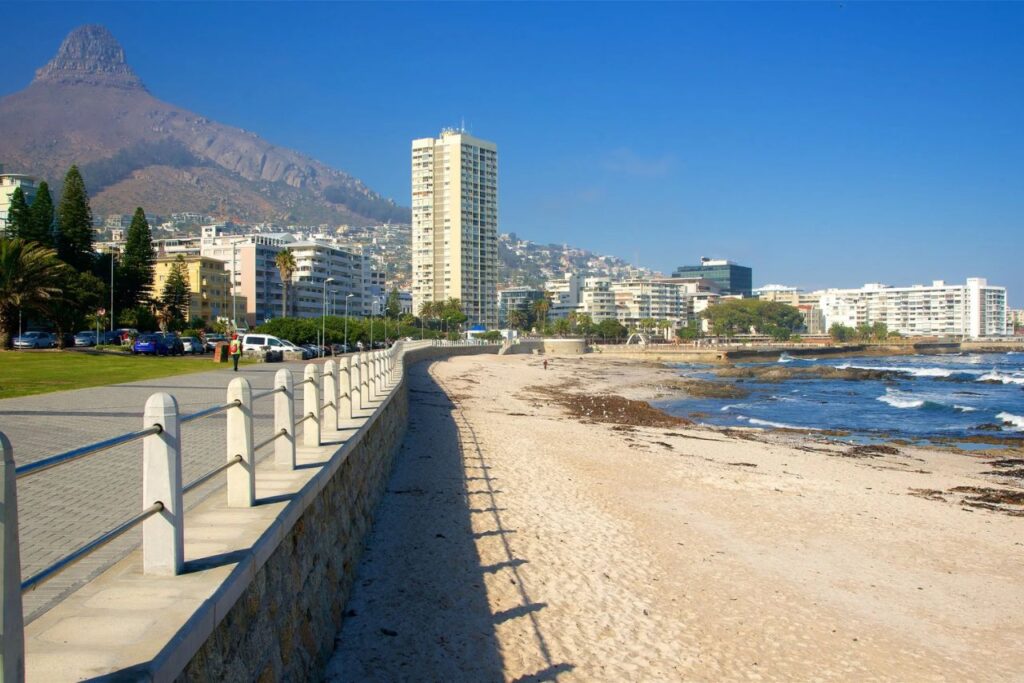
Sea Point represents the pulsing heart of Cape Town’s digital nomad community. The 11-kilometer paved promenade hosts runners, cyclists, and sunset watchers every evening with heavy foot traffic.
Regent Road and Main Road are packed with specialty coffee shops, grocery markets, and co-living hubs. Security is actively maintained by the Sea Point CID, making daytime walking exceptionally comfortable.
Green Point: Urban Greenery and Stadium Connectivity
Green Point borders the massive Green Point Urban Park and the DHL Stadium. It offers a tranquil residential feel with immediate pedestrian access to the Atlantic Seaboard and downtown.
Somerset Road forms the neighborhood’s commercial backbone, lined with gym facilities, organic bakeries, and casual coworking cafes. The Green Point CID maintains regular vehicle patrols and bicycle response units.
De Waterkant: Historic Architecture and Boutique Living
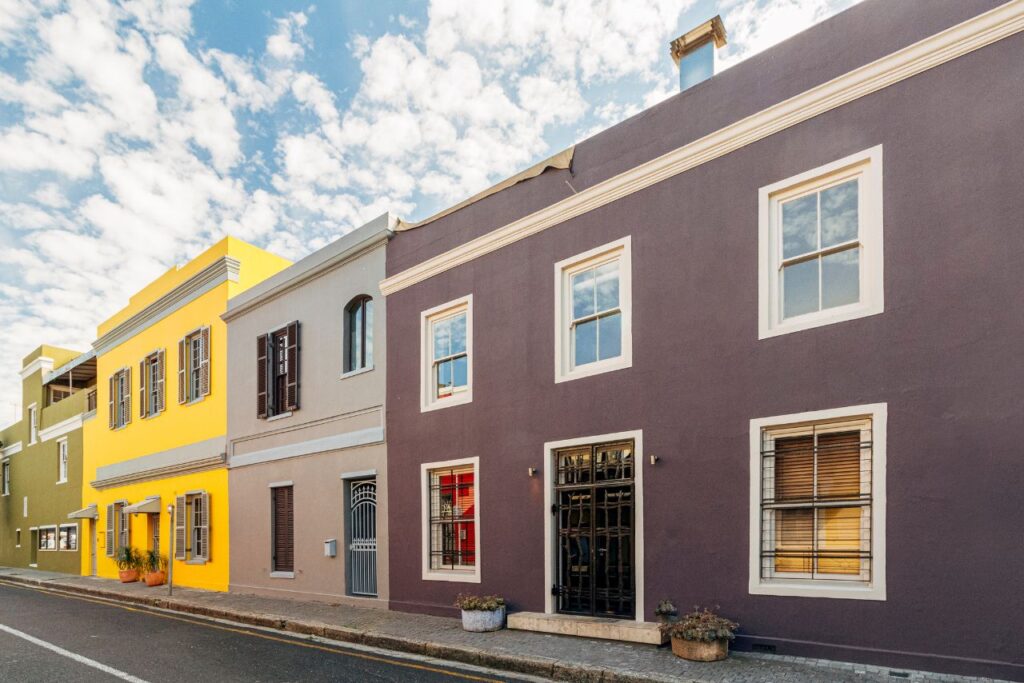
De Waterkant is renowned for its pastel-colored 18th-century cottages, cobbled lanes, and vibrant LGBTQ+ welcoming atmosphere. It feels like a bohemian European village nestled right against the central business district.
The neighborhood is exceptionally walkable by day and monitored by multiple private security networks. Accommodations here command a premium due to high demand and central convenience.
Tamboerskloof & Gardens: The Creative City Bowl
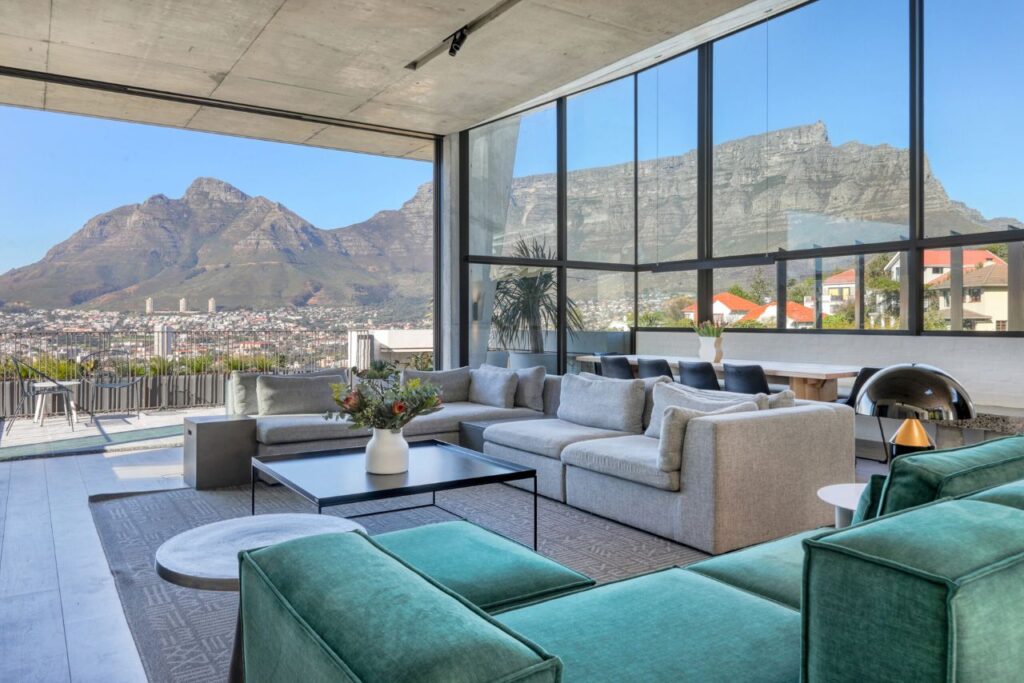
Nestled on the slopes of Lion’s Head and Table Mountain, Tamboerskloof and Gardens offer panoramic city bowl views and leafy residential streets. Kloof Street serves as the central culinary artery, brimming with indie roasteries and cocktail bars.
This area attracts long-stay writers, designers, and software engineers who prefer neighborhood cafes to coastal winds. The City Bowl CID provides visible patrols throughout commercial strips.
Which Cape Town Neighborhood Fits Your Remote Work Style?
Finding the right base depends heavily on your daily work schedule, transit preferences, and outdoor lifestyle priorities. Use this quick decision tree to narrow down your search:
- If you prioritize daily oceanfront running, dense cafe density, and meeting fellow international nomads: Choose Sea Point or Green Point. You will rarely need a rental car during daylight hours.
- If you want European-style pedestrian village charm, boutique design studios, and immediate CBD access: Base yourself in De Waterkant. It provides sophisticated urban living with strong security.
- If you prefer leafy hillside residential streets, mountain trail access, and trendy indie coffee shops: Settle in Tamboerskloof or Gardens (City Bowl) along the Kloof Street corridor.
- If your priority is beachfront luxury, expansive Atlantic sunsets, and quiet residential privacy: Look at Camps Bay or Mouille Point, and budget for regular Uber rides into town.
Remote Work Infrastructure: Solar-Backed Power and Coworking Hubs
South Africa’s electrical grid challenges, known locally as load shedding, previously caused significant concern for remote professionals. However, Cape Town’s private business infrastructure has adapted with remarkable speed.
Most modern Airbnb apartments, boutique hotels, and residential blocks in the Atlantic Seaboard now feature automated solar-battery inverter systems. These setups ensure Wi-Fi routers, monitors, and laptops remain continuously powered during scheduled outages.
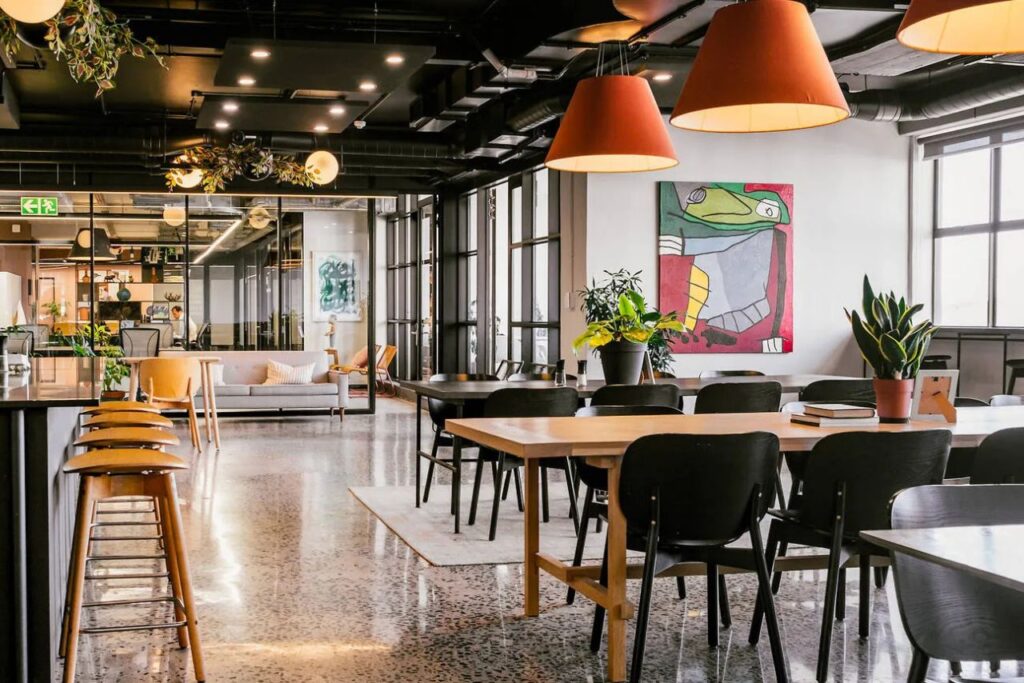
For mission-critical meetings, established coworking spaces offer 100% uptime guarantees backed by industrial diesel generators and dual redundant fiber lines. Top facilities include Workshop17 (with locations in Kloof Street and the V&A Watershed), Roamwork in Harrington Street, and Ideas Cartel in De Waterkant.
Common Misconceptions vs. Ground Realities
Navigating travel advice about South Africa requires separating outdated impressions from actual operating conditions. Here is how common fears compare against ground realities:
Myth 1: “South African Tourism monitors patrol all nomad residential streets.”
Reality: National tourism monitors are strictly stationed at major tourist monuments during daytime hours. Residential safety across Sea Point, Green Point, and De Waterkant is maintained by private City Improvement Districts and armed response companies.
Myth 2: “Digital nomads are targeted in xenophobic civil unrest.”
Reality: Populist protests target informal township trade and low-wage labor competition. In central nomad hubs, friction is rooted in rental gentrification, though Black African professionals face distinct institutional profiling.
Myth 3: “All foreign remote workers experience identical policing in Cape Town.”
Reality: Western tourists rarely face police stops, whereas Black African and Nigerian remote workers encounter significantly higher rates of SAPS document verification. Carrying certified passport and visa documentation is mandatory.
Myth 4: “You can easily switch from a 90-day tourist entry to a Remote Work Visa inside South Africa.”
Reality: The Immigration Act strictly prohibits in-country status conversion for visitor permits. Remote Work Visas under Section 11(1)(b)(iv) must be applied for and finalized abroad before arrival.
Myth 5: “Load shedding will disrupt international client video calls.”
Reality: Premium accommodations and all major coworking networks feature seamless battery inverter failovers that maintain continuous fiber connectivity without dropping a single second of connection.

Emergency Contacts & Safety Hotlines
Save these essential emergency contacts to your phone upon arrival in Cape Town for immediate assistance:
- Cape Town Central Emergency (General & Medical):
- 107 (from landline) or 021 480 7700 (from mobile phone)
- CCID Central City 24/7 Security Patrol:
- 082 415 7127
- Sea Point CID 24-Hour Emergency Dispatch:
- 086 186 1861
- National Police Emergency (SAPS Flying Squad):
- 10111
- Tourism Victim Support Helpline (Multilingual):
- 021 487 6552
Final Verdict: Balancing Lifestyle Freedom with Urban Vigilance
Cape Town remains one of the world’s most rewarding destinations for remote workers when approached with informed preparation. As highlighted in our ranking of top African digital nomad destinations, few global cities match its combination of natural beauty, culinary sophistication, and time-zone alignment with Europe.
Staying safe is not about living in fear, but about respecting spatial boundaries. Choose CID-protected neighborhoods, verify that your accommodation includes a backup inverter system, and use Uber after dark rather than walking unlit streets.
By understanding South Africa’s legal visa pathways alongside broader African travel trends and exploring most affordable African travel destinations, you can enjoy the Mother City with complete peace of mind.