Namibia unfolds across ancient rust-red dunes, fog-shrouded Atlantic shorelines, and sun-bleached desert plains where wildlife thrives against impossible odds. Traveling here feels like traversing another planet, offering unhurried road expeditions through vast, silent landscapes.
While many travelers land in Windhoek and rush between attractions, the true magic lies across the country’s distinct geographic ecosystems. From climbing the world’s highest sand peaks in Sossusvlei to watching desert-adapted lions stalk springbok around Etosha’s blinding white clay pan, every corner demands smart preparation and respect for wilderness distances.
The Operational Landscape: Evaluating Namibia’s Core Ecosystems
Understanding regional trade-offs helps you balance driving hours with immersive field experiences across wide desert corridors.
| Region and Corridor | Core Visual Highlights | Road Surface and Vehicle Needs | Ideal Time Allocation | Seasonal Weather Benchmark |
|---|---|---|---|---|
| Sossusvlei & Sesriem (Central Namib Desert) | Big Daddy Dune, Deadvlei clay pan, Dune 45, Sesriem Canyon | Paved highway to gate; soft sand track requiring 4×4 for final 5 km | 2–3 nights | Freezing desert nights (0–5°C); scorching midday sun (35°C+) |
| Etosha National Park (Northern Salt Basin) | Okaukuejo floodlit waterhole, Halali, black rhinos, elephant herds | Graded calcrete gravel; accessible by 2WD, high-clearance SUV advised | 3–4 nights | Dry winter (May–Oct) concentrates wildlife at permanent springs |
| Swakopmund & Walvis Bay (Central Atlantic Coast) | Sandwich Harbour dune drop-offs, Pelican Point kayak seals, German bakeries | Paved coastal road B2; dune descents require licensed 4×4 guide | 2–3 nights | Dense morning Benguela fog; cool coastal breezes (15–20°C year-round) |
| Damaraland & Spitzkoppe (Northwestern Erongo) | Spitzkoppe granite arch, Twyfelfontein rock art, desert-adapted elephants | Rough corrugation, sharp granite shale; sturdy 4×4 with 2 spare tires | 2–3 nights | Arid, clear skies; hot daylight hours with rapid evening cooldown |
| Skeleton Coast (Remote Northwest Coast) | Shipwrecks, Cape Cross fur seal colony, desolate fog-swept beaches | Salt-compacted roads; C34 corridor requires gate permits and emergency fuel | 1–2 nights | Cold marine currents, heavy sea fog, relentless Atlantic winds |
| Windhoek Gateway (Khomas Highland Plateau) | Christuskirche, Tintenpalast, Alte Feste, Joe’s Beerhouse, Daan Viljoen | Fully paved metropolitan streets and B1 arterial highway | 1–2 nights | Temperate plateau climate at 1,700m elevation; crisp nights |
Field Realities: 4×4 Self-Drive and Desert Expedition Protocols
Namibia is one of the world’s premier self-drive safari destinations, but its immense gravel distances demand rigorous operational discipline. Most vehicle accidents occur not from wildlife encounters, but from driving too fast on loose corrugated gravel roads.
Before leaving the capital, verify that your rental agency equips your vehicle with two full-sized spare tires, a heavy-duty jack, a tire pressure gauge, and an air compressor. Flat tires are an ordinary rite of passage rather than an emergency.
Before confirming 4×4 overland bookings, verify your consular entry paperwork well in advance. Travelers originating from regional diplomatic hubs can review the required documentation in our detailed Namibia visa application requirements before scheduling long-haul flights into Windhoek.
How should you manage tire pressure on Namibia’s gravel roads?
Deflate tires to between 1.6 and 1.8 bar (23 to 26 psi) as soon as you transition from tarmac onto gravel corridors. Lower tire pressures expand the rubber contact patch, significantly improving traction over loose stones, softening violent washboard corrugations, and dramatically reducing puncture risks.
Maintain a strict speed ceiling of 70 to 80 km/h on gravel highways, regardless of posted limits. Never brake abruptly into deep sand or loose gravel ridges, as vehicles can slide instantly into roadside ditches.
What survival supplies are non-negotiable for remote desert crossings?
Carry a minimum of 5 liters of drinking water per person per day, plus an extra 20-liter emergency water container secured in your vehicle boot. In remote corridors like Damaraland or southern Kaokoland, passing traffic can be hours apart if your engine breaks down.
Always replenish fuel whenever you encounter an operational filling station, even if your tank is still half full. Remote rural pumps frequently run dry while awaiting regional delivery tankers, and credit card terminals often lose satellite signal during rural power outages.
Sossusvlei and Deadvlei: Conquering the Ancient Rust-Red Dunes
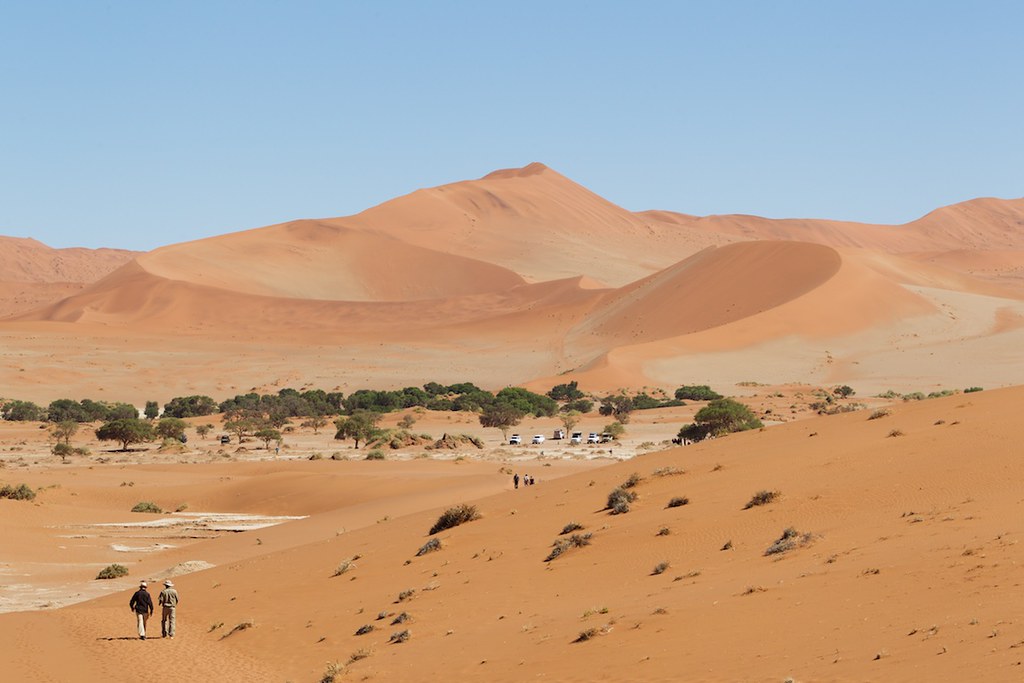
Located in the heart of the Namib-Naukluft National Park, Sossusvlei showcases some of the highest and oldest sand dunes on Earth. The sand takes its deep burnt-orange hue from millions of years of iron oxidation, standing in striking contrast against stark white clay pans and cobalt desert skies.
The iconic highlight of this region is Deadvlei, a bleached clay depression punctuated by the dark, skeletal remains of camelthorn trees that withered over 900 years ago when shifting sand dunes choked off the Tsauchab River. You can explore more of the continent’s arid marvels in our curated feature on incredible deserts in Africa.
What is the advantage of staying inside the Sesriem gate for Sossusvlei sunrise?
Booking government campsites or lodges managed by Namibia Wildlife Resorts grants you access through the inner park gate one full hour before the outer public gate opens. This single hour ensures you reach Dune 45 or Big Daddy before the morning sun creates harsh overhead glare.
Ascending Big Daddy dune requires steady footwear, a sun hat, and early departure around 06:30 AM. Once you crest the 325-meter summit ridge, running down the razor-sharp dune face directly onto Deadvlei’s white floor takes only two exhilarating minutes.
Etosha National Park: Wildlife Strategy Around Natural Waterholes
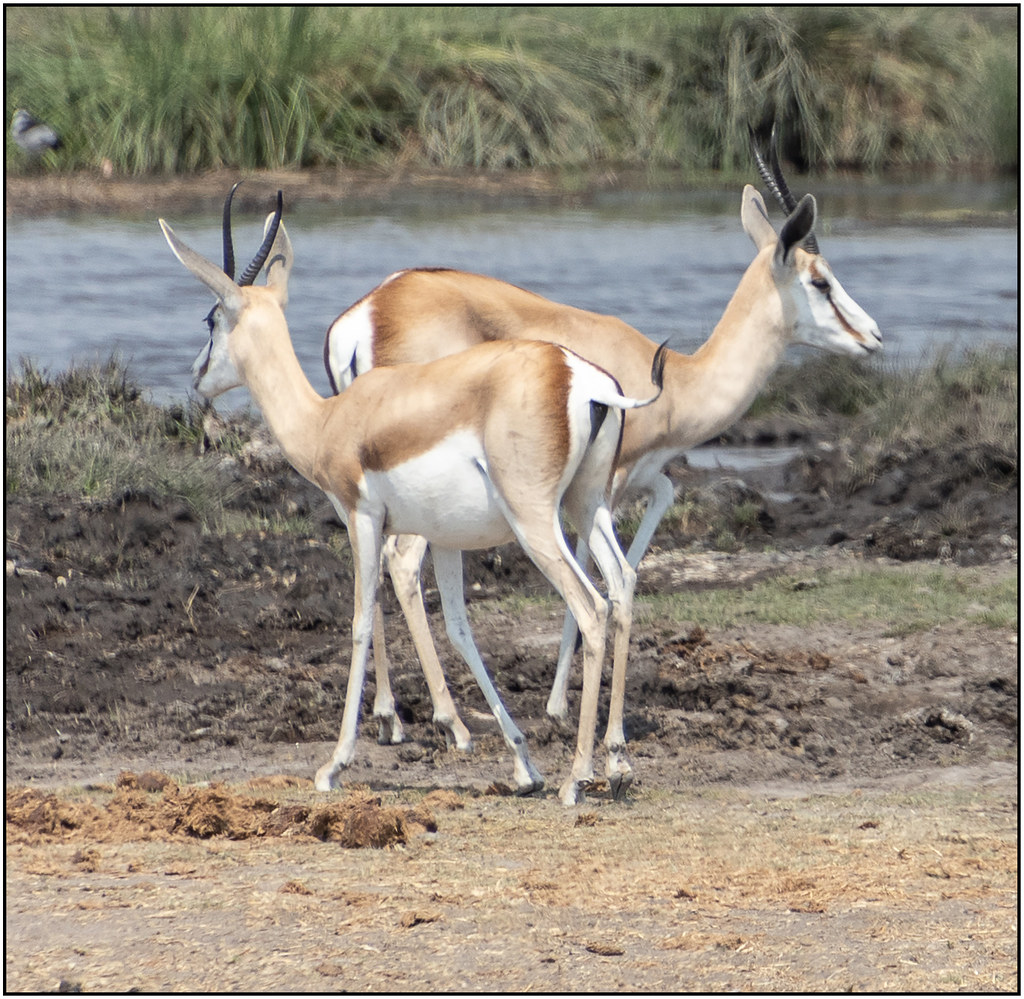
Spanning over 22,000 square kilometers, Etosha National Park centers on a vast shimmering mineral pan so large it can be seen from space. During the dry winter months, vegetation thins and animals must congregate around natural artesian springs and boreholes.
Unlike private game reserves in East Africa where safari trackers chase radio calls, safari success in Etosha relies on supreme patience. Comparing vehicle-based watching with tracking wildlife on foot is detailed in our guide on walking safaris vs game drives.
Why is patient waterhole sitting better than driving long loops in Etosha?
Parking at a single active waterhole like Okaukuejo, Chudop, or Nebrownii for two hours yields far richer wildlife encounters than covering hundred-kilometer road loops. Thirsty breeding herds of elephants, springbok, oryx, and stealthy lion prides must eventually come down to drink.
The floodlit waterhole at Okaukuejo Rest Camp offers legendary nocturnal game viewing directly from wooden benches behind a stone boundary wall. Critically endangered black rhinos frequently emerge out of the pitch darkness to drink side-by-side with spotted hyenas and giraffe herds. Travelers combining multiple wilderness corridors often compare these dry pan predator dynamics to cheetah tracking in Botswana across the neighboring Kalahari basin.
Swakopmund and Sandwich Harbour: Where Atlantic Waves Meet Coastal Dunes
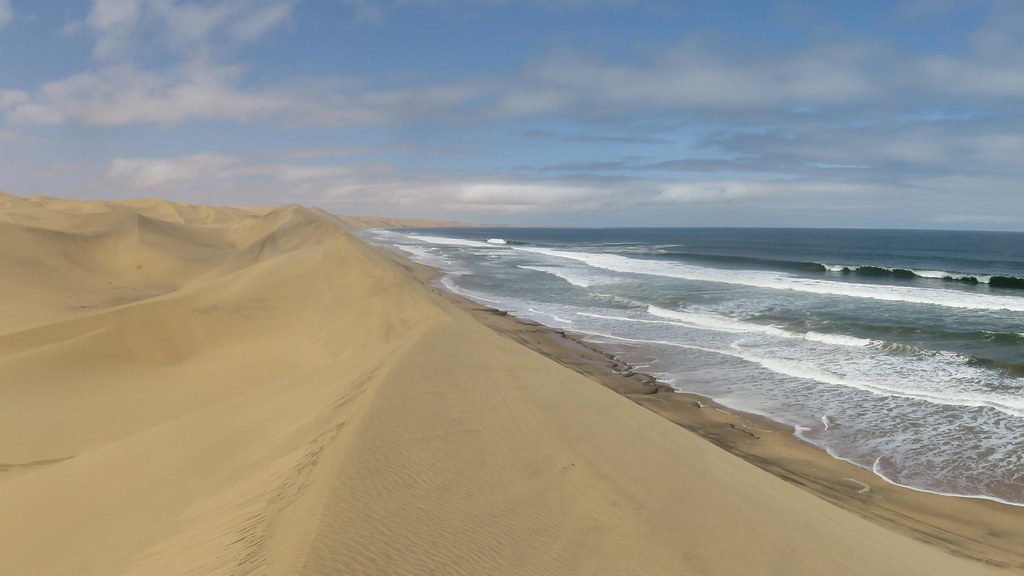
Flanked by the crashing Atlantic Ocean on one side and the Namib sand dunes on the other, Swakopmund is Namibia’s premier coastal hub. The town boasts German colonial architecture, seaside promenades, microbreweries, and crisp maritime air that offers sweet relief after sweltering desert journeys.
Thirty kilometers south lies Walvis Bay, home to a massive tidal lagoon hosting hundreds of thousands of greater and lesser flamingos. The ultimate coastal adventure is a guided 4×4 expedition south to Sandwich Harbour, where sheer sand precipices plunge straight into turbulent ocean breakers.
Never attempt to drive private vehicles along the tidal beach corridor to Sandwich Harbour without professional guides. Sudden high tides, shifting sand channels, and treacherous quicksand patches regularly submerge unwary rental vehicles within minutes.
Spitzkoppe and Damaraland: Ancient Granite Inselbergs and Rock Art
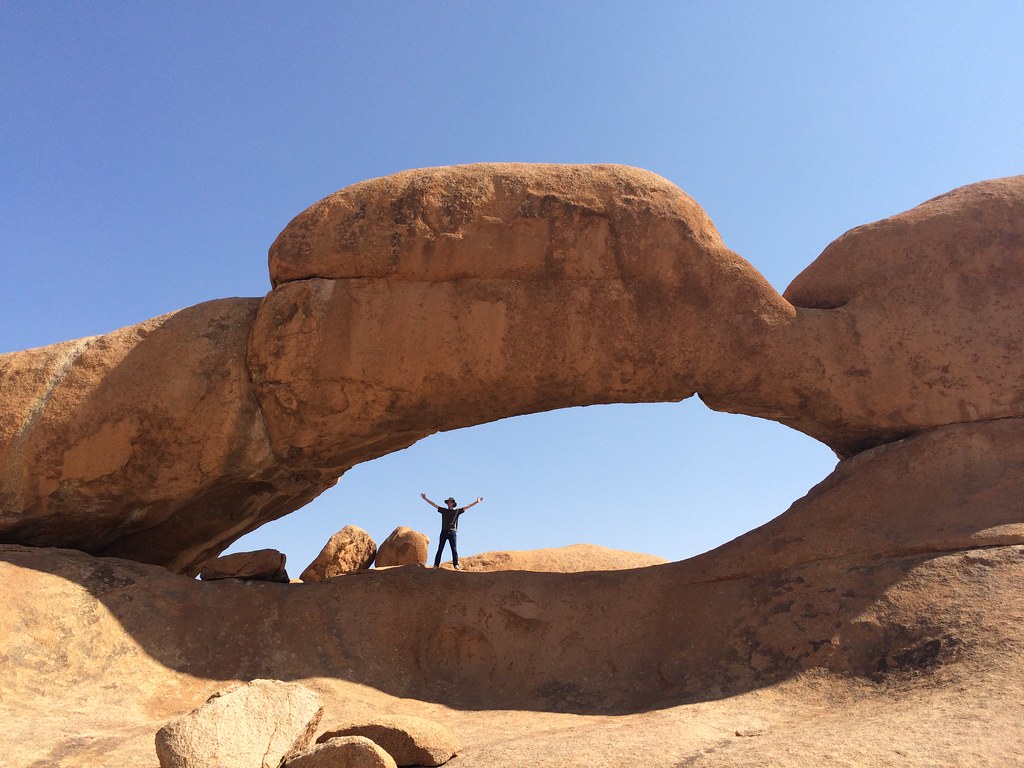
Rising dramatically from the flat desert gravel like an African Matterhorn, Spitzkoppe is an inselberg of 120-million-year-old bald granite peaks. The landscape contains sweeping natural stone bridges, hidden rock pools, and prehistoric San rock art panels etched into sheltering granite alcoves.
Further north into Damaraland, travelers encounter Twyfelfontein, a designated World Heritage site documented by the UNESCO World Heritage Centre for containing one of the densest concentrations of prehistoric hunter-gatherer rock engravings in Africa.
Damaraland is also the premier territory for travelers interested in tracking desert elephants in Namibia, where rare family herds survive along dry sand river valleys like the Aba-Huab and Ugab. Respect all local tracking guidelines and maintain safe distances of at least 50 meters from wild bull elephants.
Windhoek Gateway: Architectural Landmarks and Mountain Nature Reserves
Surrounded by the rolling Auas and Eros mountains at 1,700 meters above sea level, Windhoek serves as Namibia’s clean, modern, and accessible capital. Spending a full day here lets you adapt to the desert climate, stock expedition groceries, and experience historical landmarks.
Christuskirche: Lutheran Heritage in Sandstone

Constructed in 1910, Christuskirche stands as Windhoek’s most recognizable architectural landmark on a central traffic island near Robert Mugabe Avenue. Built from indigenous quartz sandstone quarried from the nearby Avis Dam, the church blends Gothic revival and Art Nouveau styles.
Its soaring 24-meter spire, colorful stained-glass windows gifted by Emperor Wilhelm II, and bronze bells cast in Germany make it an essential stop for architectural photography during early morning light.
Tintenpalast: Parliament Gardens and Political Seat
Directly above Christuskirche sits the Tintenpalast, which translates directly to the “Ink Palace” in playful tribute to the endless official paperwork generated by colonial administrators. Today, the structure houses both houses of Namibia’s National Parliament.
The surrounding botanical gardens provide a serene urban refuge filled with olive groves, towering bougainvillea, and indigenous desert trees where locals relax during lunch hours.
Alte Feste: Historic Fortress on the Ridge
Erected in 1890, the whitewashed Alte Feste fortress stands as the oldest surviving colonial building in Windhoek. Originally built to secure military headquarters during frontier expansion, the site offers sweeping elevated vistas across the central city basin.
While the internal museum exhibitions undergo conservation updates, viewing the fortress exterior and adjacent Independence Memorial Museum provides deep historical perspective on Namibia’s liberation struggle.
Heroes’ Acre: Monument to National Independence
Situated ten kilometers south of Windhoek along the B1 highway, Heroes’ Acre is a monumental national war memorial framed against the backdrop of surrounding mountains. The memorial honors the men and women who fought for Namibian independence.
An imposing bronze statue of the Unknown Soldier stands at the apex of grand marble stairs, alongside an eternal flame and elevated terrace delivering 360-degree panoramas of the Khomas plateau.
Daan Viljoen Game Reserve: Nature Walks on the City Fringe
Located just 24 kilometers west of downtown Windhoek in the rolling Khomas Hochland hills, Daan Viljoen Game Reserve offers a rare walking safari sanctuary. Because there are no large predators here, visitors are free to explore marked hiking trails on foot.
The 9-kilometer Sweet Thorn Trail weaves through dry acacia riverbeds and mountain ridges where you can regularly spot Hartmann’s mountain zebras, blue wildebeest, gemsbok, and over 200 resident bird species.
Joe’s Beerhouse: Craft Game Meats and Desert Atmosphere
No journey through Windhoek is complete without an evening dinner at Joe’s Beerhouse in the Eros suburb. This iconic open-air beerhouse is famously decorated with antique safari memorabilia, vintage motorbikes, and old enamel signage collected over decades.
The kitchen specializes in hearty game skewers featuring kudu, zebra, springbok, and oryx served with craft draught beers and sweet potato mash. Reserving an outdoor wooden bench table in advance is essential during peak safari months.
Field Myths vs. Operational Realities in Namibia
Separating common travel assumptions from real-world conditions ensures a seamless desert expedition across southern Africa.
Myth 1: You can easily drive between major parks in two or three hours.
Reality: Namibia is roughly twice the size of California with vast distances between destinations. Driving from Windhoek to Sossusvlei takes 5 to 6 hours over corrugated gravel, while driving from Sossusvlei to Swakopmund requires another 5 hours through isolated mountain passes like the Gaub and Kuiseb Canyons. Travelers extending their road trip eastward through the Zambezi strip frequently add dedicated buffer days for swimming in Devil’s Pool at Victoria Falls.
Myth 2: Deserts are always blisteringly hot year-round.
Reality: While summer days between December and February can exceed 40°C, winter nights between June and August in the Namib Desert regularly drop below freezing (0°C). Furthermore, coastal towns like Swakopmund stay cool and fog-drenched year-round due to the icy Benguela ocean current, requiring fleece jackets even in mid-summer.
Myth 3: Any rental sedan can handle a national tour.
Reality: While major routes like the B1 and B2 are paved highways, access roads to Sossusvlei, Spitzkoppe, and northern game lodges are gravel tracks with sharp stones, deep sand berms, and severe washboard ruts. Renting a sturdy 4×4 or high-clearance SUV is essential for safety, comfort, and insurance validity.
For official park entry protocols, seasonal gate regulations, and national conservation announcements, consult the Ministry of Environment, Forestry and Tourism before departing.